
1By Jin Ming Lim
I. Introduction
Singapore’s trial processes for civil matters are enshrined in the Rules of Court 2021 (“ROC”). This commentary seeks to give an overview of the civil trial process in both the State Courts and the Supreme Court, and hopefully demystify the requirements as well.
II. Civil Trials
Statistically, a civil case will often originate in the State Courts, which include the District Courts and Magistrates’ Courts.2 A civil case determines whether the rights and obligations of individuals, owed to other individuals, has been breached.3 In contrast, a criminal case determines whether a person accused of a crime should be charged and punished.4 The aims of the civil trial process are: (a) fair access to justice; (b) expeditious proceedings; (c) cost-effective work proportionate to the: nature and importance of the action, the claim’s complexity or difficulty or novelty, and its value; (d) efficient use of court resources; and (e) fair and practical results.5
This article addresses proceedings in both the State Courts and the Supreme Court, as their processes are broadly similar in structure due to the application of the ROC.6 Where relevant, material differences will be highlighted.
The claimant, the party bringing the claim or responding to a counterclaim,7 begins a case via either an originating application (“OA”) or an originating claim (“OC”).8 To understand which process to use, the claimant should take note of the differing requirements:
| Type of document | Requirements |
| OA | When the application is required by law, or concerns matters of law where the material facts are not in dispute.9 |
| OC | When the material facts are in dispute.10 |
Importantly, there are also time limits for filing both processes, after which the claim will generally be time-barred,11 such that no action may be brought (limited exceptions apply).12
| Nature of Claim | Deadline |
| Contract and/or tort | Within six (6) years of dispute. |
| Personal injury | Within three (3) years of dispute. |
| Recovery of land and rent action | Within 12 years of dispute. |
(1) Originating Applications
There are five main steps to an OA:
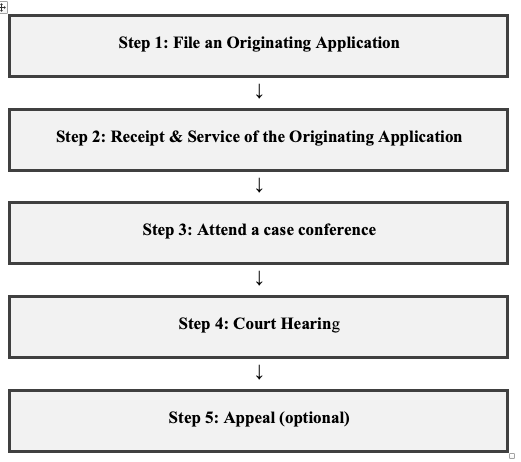
(a) Step 1: File an Originating Application
Parties must file their OA to the appropriate court, depending on the value and nature of their claim:
| Value and Nature of Parties’ Claim | The Correct Court |
| Lower than $60,000.13 | Magistrate’s Court. |
| Between $60,000 and $250,000;14 or up to $500,000 for road traffic accident claims or claims for personal injuries arising out of industrial accidents.15 | District Court. |
| Exceeding $250,000;16 or exceeding $500,000 for road traffic accident claims or claims for personal injuries arising out of industrial accidents.17 | General Division of the High Court. |
Parties must file an OA using either Form 15 or 16 in Appendix A of the Supreme Court Practice Directions 2021 (“SUCPD”),18 or Forms 15 or 16 in Appendix A2 of the State Courts Practice Directions 2021 (“STCPD”).19 Form 15 is used when the OA has to be served on (given to) the relevant party, whereas Form 16 is used when the OA need not be served on anyone.20 Notice is unnecessary if the OA is served on an agent or manager of the principal,21 or if it is a claim for possession of immovable property.22
For trials filed in the Supreme Court, the claimant must, together with the OA,23 also submit an affidavit, which is a document that contains all necessary evidence.24 The affidavit must be produced in English, signed and affirmed before a commissioner for oaths.25
(b) Step 2: Receipt and Service of the Originating Application
If the Court accepts the claimant’s OA application, the claimant will receive a copy of the sealed OA. The claimant must then serve it on the defendant,26 within 14 days after the OA is issued if it is to be served in Singapore,27 or 28 days if it is to be served outside Singapore.28
Defendants (the party contesting the claim by the claimant)29 may introduce evidence in respect of the OA filed against them via their supporting affidavit.30 To do so, they must file and serve it either within 21 days of service if they are in Singapore,31 or within five (5) weeks if they are outside Singapore.32 If the defendant does not meet the given deadline, the Court may dismiss the action or order the claimant to serve the affidavit.33 If the defendant wishes to counterclaim against the claimant, they must also include their counterclaim in their affidavit.34
(c) Step 3: Attend a case conference
The Court will then fix a case conference,35 within eight (8) weeks after the OA is issued if the defendant is in Singapore, or 12 weeks if the defendant is outside Singapore.36 The case conference allows the Court to take control, set timelines and give directions.37 If no party attends the case conference or the claimant is absent, the Court may dismiss the action. Conversely, if the defendant is absent or fails to serve their defence or affidavit, the Court may give judgement for the claimant.38
For Supreme Court filings, parties must also complete a Pre-Case Conference Questionnaire (Form B6 of the SUCPD) before the case conference.39 This helps parties on key issues such as service of process, jurisdiction challenges and the nature of the claim,40 by walking them through the entire process sequentially and asking the claimant specific questions.
(d) Step 4: Attend the Court hearing
The case will generally be restricted to the parties (if legally unrepresented) or to their solicitors.41 Attendance is mandatory, and failure may result in the Court dismissing their application or making an order against the absentee.42
After the Court hearing, a decision (known as the judgment) will be given by the Court. The judgment will generally take effect from the day that the judgment is given.43
(e) Step 5: Appeal
Parties may appeal against the decision if the law allows, by filing an application to appeal.44 Parties must then file and serve a notice of appeal on all interested parties.45 It will then be heard in either the Appellate Division of the High Court or the Court of Appeal.46 During the appeal, the appropriate appellate court will rehear the documents filed in the court below.47 At this juncture, documents (other than the parties’ written submissions) may only be filed or admitted with the appellate Court’s approval.48
(2) Originating Claims (Default Process)
An OC can proceed under two different procedural tracks: the default process and the simplified process.
| Types of OCs | Requirements |
| OC (default) | Claim amount is between $60,000 to $250,000,49 or up to $500,000 for road traffic accident claims or claims for personal injuries arising out of industrial accidents (District Court).50 Claim amount exceeds $250,000,51 or exceeds $500,000 for road traffic accident claims or claims for personal injuries arising out of industrial accidents (General Division of the High Court).52 |
| OC (simplified) | Claim amount does not exceed $60,000 (Magistrate’s Court).53 Claim amount is between $60,000 to $250,000,54 or up to $500,00 for road traffic accident claims or claims for personal injuries arising out of industrial accidents (Magistrate’s Court or District Court);55 and parties must consent to the simplified civil process.56 |
The default process involves the following main steps:
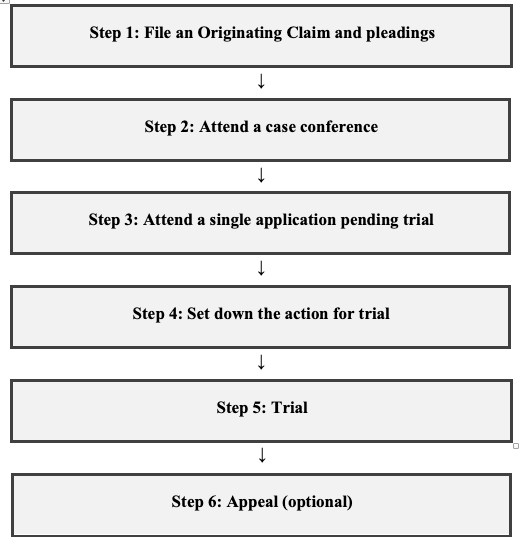
(a) Step 1: File an Originating Claim
An OC is a formal document,57 found at Form 8 of both the Practice Directions, addressed to the defendant to notify them of proceedings. An OC is submitted by the claimant, (often through their lawyer) via the court’s filing systems,58 generally with a brief description of the claim, as instructed by Form 9 of both the Practice Directions.59 For claims for personal injuries, the claimant must also annex a medical report and a statement of special damages.60 Failure to take reasonable steps to see that the OC is served may lead the Court to dismiss the action.61
After an OC is filed, defendants must file and serve a notice of intention to either contest or not contest the claim.62 This notice of intention63 must be served within 14 days after receipt of the statement of claim if they are in Singapore,64 or within 21 days if they are outside Singapore.65 If the defendant fails to either file or serve, the claimant may apply for default judgment against the defendant.66
If a notice of intention to contest has been filed, the defendant must file and serve a defence to the OC67 within 21 days of receipt of the statement of claim if they are in Singapore,68 or five weeks if they are outside Singapore.69 If the claimant only wishes to deny the assertions in defendant’s defence, he need not file a reply.70
The defendant can file a counterclaim in the same action if they wish.71 In turn, the claimant must file and serve a defence to the counterclaim72 within 14 days after the defence and counterclaim are served on the claimant.73
At this juncture, parties cannot file further pleadings74 unless the Court so allows.75
(b) Step 2: Attend a case conference
The process is identical to that outlined at paragraphs 14 to 15.76
(c) Step 3: Attend a single application pending trial
Once parties notify the Court, the Court will as far as possible order a single application pending trial (“SAPT”) to be made.77 The SAPT must deal with necessary matters for the case to proceed expeditiously,78 such as the addition or removal of parties, consolidation of actions, or amendment of pleadings.79 Each party must file and serve the application, with a supporting affidavit, within 21 days of the case conference, and the other party must file and serve an affidavit in reply within 21 days thereafter.80
(d) Step 4: Set down the action for trial
After the SAPT, the Court will direct the claimant to file the Notice for Setting Down Action for Trial,81 which refers to the scheduling for trial.82 It must state the length of trial, trial dates and witnesses that parties wish to bring.83 Additionally, it must be served on all parties within 24 hours after filing.84
Parties will now be directed to file and serve the affidavits of evidence-in-chief (“AEIC”), bundles of documents, opening statements and bundle of authorities.85 These will be explained in turn in paragraphs 29 to 32.
The AEIC contains the originals of the witnesses’ affidavits to be relied on.86 There is also a 30-page limit (excluding exhibits)87 unless the Court otherwise orders.88
The accompanying bundle of documents typically contains the documents that parties will rely on during trial, including all previous pleadings and relevant Court orders from case conferences.89 They must also be arranged meaningfully (for example, in chronological order) and must exclude repeat documents or documents not yet exchanged or produced under Order 11.90 They are governed by the SUCPD at paragraphs 102(7)–(13),91 or STCPD at paragraphs 73(5)–(11).92
Opening statements are a maximum 25-page93 written summary of the case and the issues to be decided by the Court, both of fact and law.94
A bundle of authorities, which is optional to file, contains authorities, cases, statutes, subsidiary legislation and other materials that parties intend to rely on.95 However, the Court may nevertheless mandate parties to file them.96
Crucially, parties must inform witnesses of the date and place for trial; if they do not attend, parties’ AEICs may be rejected. If the witness is uncomfortable communicating in English, parties should arrange for interpretation services.97 If the witness is unwilling to attend, parties should apply for a subpoena via eLitigation attendance.98
(e) Step 5: Trial
The trial involves a hearing of the merits on the OC, and involves all applications filed after the start of the hearing until the giving of the judgment.99 The Court will deliver judgment orally or in writing at the conclusion of the hearing of the application or at a subsequent date,100 with the latter being available to parties at a fee.101
(f) Step 6: Appeal
The process is identical to the aforementioned at paragraph 18.102
(3) Originating Claims (Simplified Process)
The simplified process involves the following main four steps:
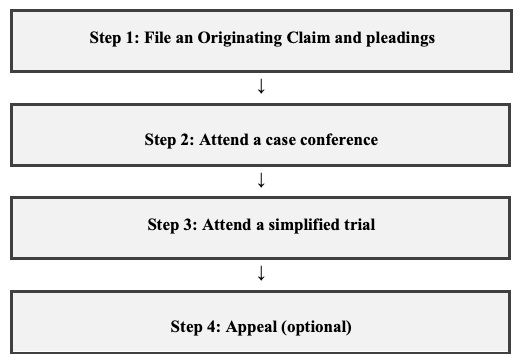
(a) Step 1: File an Originating Claim and pleadings
The process is similar to the default process described above.103 However, in the simplified process, the timeline is potentially accelerated because the Court first works together with both parties to explore solutions, before proceeding to trial.
Additionally, for claims involving personal injury, non-injury motor accidents, negligence and medical negligence, the Court will follow the requirements of paragraphs 38 to 41 of the STCPD (which includes matters such as submission timelines and documents to submit).104
(b) Step 2: Attend a case conference
The Court will then generally fix a first case conference around seven (7) weeks from the filing of the defence,105 with a notice issued to the claimant and any party who has filed a notice of intention to contest.106 If both parties are represented, a case conference will be done remotely via video conferencing. If at least one party is unrepresented, a physical case conference will be fixed.107
To prepare, parties should seven (7) days before the CC,108 exchange proposals in writing using Form 4 of the STCPD.109 Thereafter, they should file it through the Electronic Filing Service.110
If the Court, at this juncture, is satisfied that parties cannot resolve their dispute without trial, the Court will order a simplified trial under Order 65 or a full trial under Order 15,111 based on factors such as the number of parties, complexity of the issues, amount of the claim or counterclaim, proportionality of costs and nature of the action.112
(c) Step 3: Attend a simplified trial
The Court will thereafter make the appropriate orders. During the trial, parties must abide by the relevant time limits for examinations of witnesses and for closing submissions,113 although the Court may extend the timing at their discretion.114
(d) Step 4: Appeal
The process is identical to the aforementioned at paragraph 18.115
III. Further Developments
Two observations from members of the Judiciary are worth highlighting. Firstly, at the Opening of the Legal Year 2026, Menon CJ remarked that the Courts are looking towards implementing Generative Artificial Intelligence in the court system. He noted that the Small Claims Tribunals are already implementing on-demand translations of Court documents with our official languages.116
Second, the multiple roles of the court merit attention. As espoused by Justice Vincent Hoong, the court is most known for its adjudicatory role. However, the relatively less discussed systemic role it plays is equally important, particularly to “develop and operate a system for the administration of justice that is accessible to all and meets the needs of all”.117
— — — For a PDF version of this article, click here — — —
- Year 2 LL.B. student, Yong Pung How School of Law, Singapore Management University. Edited by: Ong Ee Ing, Principal Lecturer, Singapore Management University Yong Pung How School of Law. This publication does not necessarily deal with every important topic or cover every aspect of the topics with which it deals. It is not designed to provide legal or other advice. ↩︎
- Singapore Courts, “Role of the State Courts” <https://www.judiciary.gov.sg/who-we-are/role-structure-state-courts/role> (accessed 23 March 2026). The State Courts also includes Small Claims Tribunals, Community Disputes Resolution Tribunals, and Employment Claims Tribunals; however, this article will not discuss the tribunals because they have their own processes and legislation. Small Claims Tribunals Act 1984 (2020 Rev Ed); Community Disputes Resolution Act 2015 (2020 Rev Ed); Employment Claims Act 2016 (2020 Rev Ed). ↩︎
- Singapore Courts, “What is a civil case?” <https://www.judiciary.gov.sg/who-we-are/what-is-civil-case> (accessed 23 March 2026). ↩︎
- Singapore Courts, “What is a criminal case?” <https://www.judiciary.gov.sg/who-we-are/what-is-criminal-case> (accessed 23 March 2026). ↩︎
- Rules of Court 2021 O 3 r 1. ↩︎
- Rules of Court 2021 O 1 r 2(3). ↩︎
- Rules of Court 2021 O 1 r 3. ↩︎
- Rules of Court 2021 O 6 r 1. ↩︎
- Rules of Court 2021 O 6 r 1(3). ↩︎
- Rules of Court 2021 O 6 r 1(2). ↩︎
- Limitation Act 1959 (2020 Rev Ed) ss 6, 9 and 24A. ↩︎
- Limitation Act 1959 (2020 Rev Ed) ss 24, 26–28. ↩︎
- State Courts Act 1970 (2020 Rev Ed) s 2. ↩︎
- State Courts Act 1970 (2020 Rev Ed) s 2. ↩︎
- Supreme Court of Judicature (Transfer of Specified Proceedings to District Court) Order 2016 s 2A. ↩︎
- State Courts Act 1970 (2020 Rev Ed) s 2. ↩︎
- Supreme Court of Judicature (Transfer of Specified Proceedings to District Court) Order 2016 s 2A. ↩︎
- Supreme Court Practice Directions 2021 para 57(2). ↩︎
- State Court Practice Directions 2021 para 24(2). ↩︎
- Rules of Court 2021, O 6 r 11(2)–(3). ↩︎
- Rules of Court 2021 O 7 r 4. ↩︎
- Rules of Court 2021 O 7 r 5. ↩︎
- Supreme Court Practice Directions 2021 para 64(1). ↩︎
- Rules of Court 2021 O 6 r 13. ↩︎
- Rules of Court 2021 O 15 r 18. ↩︎
- Rules of Court 2021 O 6 r 11. ↩︎
- Rules of Court 2021 O 6 r 11(4). ↩︎
- Rules of Court 2021 O 6 r 11(5). ↩︎
- Rules of Court 2021 O 1 r 3. ↩︎
- Rules of Court 2021 O 6 r 12. ↩︎
- Rules of Court 2021 O 6 r 12(1). ↩︎
- Rules of Court 2021 O 6 r 12(2). ↩︎
- Rules of Court 2021 O 2 r 6(3). ↩︎
- Rules of Court 2021 O 6 r 14. ↩︎
- Rules of Court 2021 O 2 r 6(1). ↩︎
- Rules of Court 2021 O 9 r 1(1). ↩︎
- Rules of Court 2021 O 9 r 2. ↩︎
- Rules of Court 2021 O 2 r 6(4)–(5). ↩︎
- Supreme Court Practice Directions 2021 para 56(2). ↩︎
- Supreme Court Practice Directions 2021 para 56(2), citing Appendix B, Form B6. ↩︎
- Rules of Court 2021 O 15 r 1(5). ↩︎
- Rules of Court 2021 O 15 r 7(4). ↩︎
- Rules of Court 2021 O 17 r 2(1). ↩︎
- Rules of Court 2021 O 2 r 10(1). ↩︎
- Rules of Court 2021 O 2 r 10(3). ↩︎
- Rules of Court 2021 O 15 r 1(3). ↩︎
- Rules of Court 2021 O 2 r 10(8). ↩︎
- Rules of Court 2021 O 2 r 10(10)–(11). ↩︎
- State Courts Act 1970 (2020 Rev Ed) s 2. ↩︎
- Supreme Court of Judicature (Transfer of Specified Proceedings to District Court) Order 2016 s 2A. ↩︎
- State Courts Act 1970 (2020 Rev Ed) s 2. ↩︎
- Supreme Court of Judicature (Transfer of Specified Proceedings to District Court) Order 2016 s 2A. ↩︎
- State Courts Act 1970 (2020 Rev Ed) s 2. ↩︎
- State Courts Act 1970 (2020 Rev Ed) s 2. ↩︎
- Rules of Court 2021 O 65 r 1(1). ↩︎
- Rules of Court 2021 O 65 r 1(2). ↩︎
- Rules of Court 2021 O 6 r 5(1), citing Supreme Court Practice Directions 2021, Appendix A, Form 8 and State Court Practice Directions 2021, Appendix A1, Form 8. ↩︎
- Supreme Court Practice Directions 2021 para 32; State Courts Practice Directions 2021 para 83. ↩︎
- Rules of Court 2021 O 6 r 5(3), citing Supreme Court Practice Directions 2021, Appendix A, Form 9 and State Court Practice Directions 2021, Appendix A1, Form 9. ↩︎
- Rules of Court 2021 O 6 r 5(2). ↩︎
- Rules of Court 2021 O 9 r 5. ↩︎
- Rules of Court 2021 O 6 r 6. ↩︎
- Rules of Court 2021 O 6 r 6(3), citing Supreme Court Practice Directions 2021, Appendix A, Form 10 and State Court Practice Directions 2021, Appendix A1, Form 10. ↩︎
- Rules of Court 2021 O 6 r 6(1). ↩︎
- Rules of Court 2021 O 6 r 6(2). ↩︎
- Rules of Court 2021 O 6 r 6(5). ↩︎
- Rules of Court 2021 O 6 r 7(3) citing Supreme Court Practice Directions 2021, Annex A, Form 13 and State Court Practice Directions 2021, Appendix A2, Form 13. ↩︎
- Rules of Court 2021 O 6 r 7(1). ↩︎
- Rules of Court 2021 O 6 r 7(2). ↩︎
- Rules of Court 2021 O 6 r 9. ↩︎
- Rules of Court 2021 O 6 r 8(2), citing Supreme Court Practice Directions 2021, Form 13 of Appendix A, and State Court Practice Directions 2021, Appendix A2, Form 13. ↩︎
- Rules of Court 2021 O 6 r 9(2), citing Supreme Court Practice Directions 2021, Form 13 of Appendix A, and State Court Practice Directions 2021, Appendix A2, Form 13. ↩︎
- Rules of Court 2021 O 6 r 9(1). ↩︎
- Rules of Court 2021 O 6 r 10(2). ↩︎
- Rules of Court 2021 O 6 r 10(1). ↩︎
- Paras 14–15. ↩︎
- Rules of Court 2021 O 9 r 9(1). ↩︎
- Rules of Court 2021 O 9 r 9(4). ↩︎
- Rules of Court 2021 O 9 r 9(4). ↩︎
- Rules of Court 2021 O 9 r 9(5). ↩︎
- Rules of Court 2021 O 9 r 25(1). ↩︎
- Rules of Court 2021 O 9 r 25(6), citing Supreme Court Practice Directions 2021, Appendix A, Form 19, and State Court Practice Directions 2021, Appendix A2, Form 19. ↩︎
- Rules of Court 2021 O 9 r 25(7). ↩︎
- Rules of Court 2021 O 9 r 25(8). ↩︎
- Rules of Court 2021 O 9 r 25(9). ↩︎
- Singapore Courts, “File documents for civil trial – AEIC” <https://www.judiciary.gov.sg/civil/going-to-court-civil-trial/file-documents-for-civil-trial#aeic> (accessed 4 February 2026). ↩︎
- Rules of Court 2021 O 46A r 3(3). ↩︎
- Rules of Court 2021 O 46A r 4. ↩︎
- Rules of Court 2021 O 9 r 25(10). ↩︎
- Rules of Court 2021 O 9 r 25(11). ↩︎
- Supreme Court Practice Directions 2021 paras 102(7)–(13). ↩︎
- State Court Practice Directions 2021 paras 73(5)–(11). ↩︎
- Rules of Court 2021 O 9 r 25(9)(c). ↩︎
- Supreme Court Practice Directions 2021 para 102(14); State Court Practice Directions 2021 paras 73(12). ↩︎
- Rules of Court 2021, O 19 r 3. ↩︎
- Supreme Court Practice Directions 2021 para 102(15); State Court Practice Directions 2021 para 73(13). ↩︎
- Singapore Courts, “Arrange for Interpretation Services <https://www.judiciary.gov.sg/services/interpretation-services> (accessed 14 January 2026); Supreme Court Practice Directions 2021 para 16; State Court Practice Directions 2021 para 66. ↩︎
- Singapore Courts, “Apply to summon a witness” <https://www.judiciary.gov.sg/services/summon-witness> (accessed 14 January 2026). ↩︎
- Rules of Court 2021 O 19 r 3. ↩︎
- Rules of Court 2021 O 19 r 12(1). ↩︎
- Rules of Court 2021 O 19 r 12(3). ↩︎
- Para 16. ↩︎
- Paras 19–23. ↩︎
- State Court Practice Directions 2021 para 36(2A). ↩︎
- State Court Practice Directions 2021 para 36(3)(a). ↩︎
- State Court Practice Directions 2021 para 36(3)(b). ↩︎
- State Court Practice Directions 2021 para 36(3)(c). ↩︎
- State Court Practice Directions 2021 para 36(4). ↩︎
- State Court Practice Directions 2021 para 36(4)(a). ↩︎
- State Court Practice Directions 2021 para 36(4)(b). ↩︎
- Rules of Court 2021 O 65 r 4(1). ↩︎
- Rules of Court 2021 O 65 r 4(2). ↩︎
- Rules of Court 2021 O 65 r 4(3). ↩︎
- Rules of Court 2021 O 65 r 4(4). ↩︎
- Paragraph 16. ↩︎
- Singapore Courts, “Chief Justice Sundaresh Menon: Response delivered at the Opening of The Legal Year 2026” (12 January 2026) <https://www.judiciary.gov.sg/news-and-resources/news/news-details/chief-justice-sundaresh-menon–response-delivered-at-the-opening-of-the-legal-year-2026> (accessed 25 January 2026). ↩︎
- Justice Vincent Hoong, “Speech delivered at Conversations with the Community on 24 January 2024” (Conversations with the Community, 24 January 2024) Singapore Courts <https://www.judiciary.gov.sg/news-and-resources/news/news-details/justice-vincent-hoong-speech-delivered-at-conversations-with-the-community-on-24th-january-2024> (accessed 10 March 2026). ↩︎
 smulexicon.com