
By: Aretha Quek[1]
I. Introduction
Disputes between neighbours are common in Singapore’s densely populated urban environment. With approximately 80% of Singaporeans residing in HDB flats,[2] many Singaporeans find themselves living in close proximity to their neighbours. As a result, conflicts inevitably arise over issues such as the use of shared spaces or noise disturbances. Some residents may find their neighbours’ behaviour intrusive, resulting in tension over their personal space.
To address neighbour disputes, the Community Disputes Resolution Act 2015 (“CDRA”) was enacted on 13 March 2015.[3] The CDRA introduces a statutory tort of interference with a neighbour’s enjoyment or use of places of residence.[4] The legislation sets out specific instances of interference, such as causing excessive noise,[5] littering,[6] and obstruction of access to a neighbour’s place of residence.[7] The objective of the CDRA is to prevent individuals from causing unreasonable interference, whether through acts or omissions,[8] that disrupt a neighbour’s enjoyment of their living space.[9] Additionally, the CDRA aims to foster good neighbourly relations and encourage reconciliation through mediation before legal proceedings commence.[10]
This article aims to explain the procedure for the claimant who wishes to file a claim with the Community Disputes Resolution Tribunal (“CDRT”), and the available avenues for enforcement if the respondent fails to comply with a CDRT order.
II. When a neighbour dispute may be heard at the CDRT
Given the above aims of fostering good neighbourly relations and encouraging reconciliation, “neighbour disputes” are not immediately heard at the CDRT. Instead, neighbours are encouraged to first explore alternative dispute resolution methods, such as mediation at the Community Mediation Centre (“CMC”).[11] A claimant should consider initiating proceedings in the CDRT only after all self-help options, including community mediation, have been exhausted.[12] Any claims through the CDRT are considered a last resort, as adjudication inherently produces a “winner” and a “loser”, which might further strain neighbourly relations.[13]
Importantly, community mediation before commencing CDRT proceedings will be a mandatory requirement in due course following the passage of the Community Disputes Resolution (Amendment) Bill in November 2024.[14] In other words, claimants will not be permitted to file a CDRT claim unless they have first attempted mediation. This legislative amendment underscores Parliament’s intent to ensure that adjudication in the CDRT is one of last resort, while promoting reconciliation and preserving neighbourly relations wherever possible.[15]
III. How a neighbour dispute may be heard at the CDRT
If all self-help options have failed, the claimant can file a claim through the courts. However, filing a claim through CDRT instead of starting civil proceedings in the Magistrate’s, District or High Courts provides certain advantages. The CDRT provides a more accessible and cost-effective alternative for dispute resolution.[16] It should also be noted that parties in CDRT proceedings cannot be represented by lawyers,[17] unless the CDRT grants permission, and all parties agree.[18]
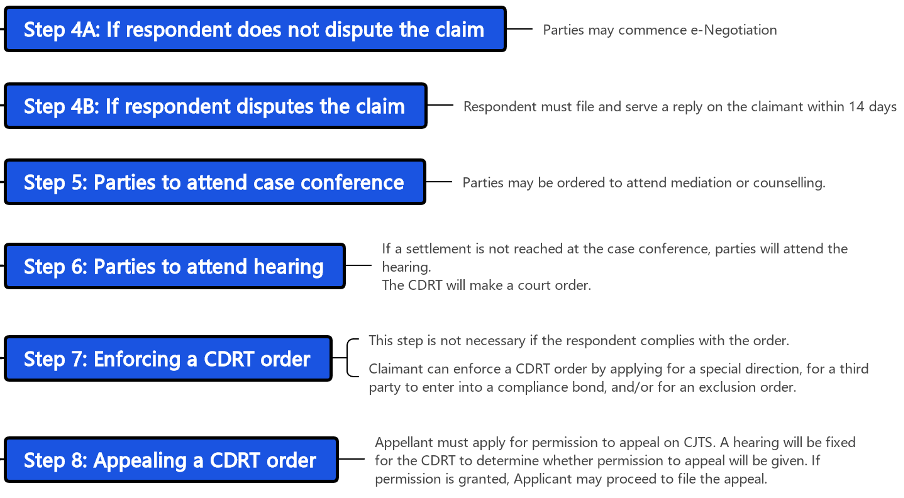
The following flowchart outlines the process if the claimant proceeds to file a claim at the CDRT:
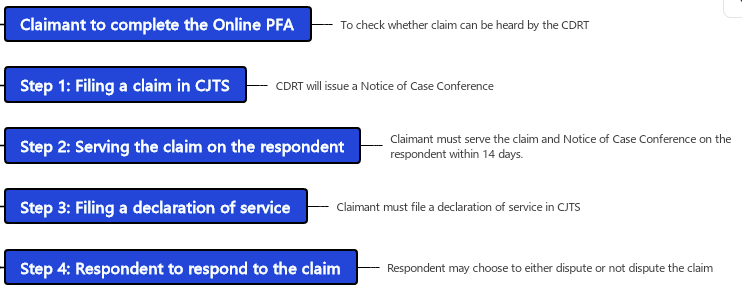
Preparatory Step: Filing a claim in CJTS
A CDRT claimant would first have to complete an Online Pre-Filing Assessment (“PFA”) on the Community Justice and Tribunals System (“CJTS”) to check whether the claim can be heard by the CDRT. Notably, the claim will be heard at the CDRT only if:
- the claim concerns an act or omission by the respondent that has caused unreasonable interference with the claimant’s enjoyment or use of his or her place of residence;[19]
- the respondent lives in the same building, or lives within a 100 metre radius;[20]
- the claim is limited to $20,000;[21]
- the claim is filed within 2 years which the act or omission has occurred;[22] and
- the claim is not pending in or has been heard and determined by any other court.[23]
If the claim is not filed within 2 years, the claimant would have to start a civil claim in the Magistrate’s Court or District Court instead. The parties can be represented by lawyers in civil proceedings.
Step 1: Filing a claim in CJTS
The claim must be filed through the CJTS via the “Claim Form” application.[24]
A. Information required
The claimant must provide five key pieces of information when filing his or her claim:[25]
- Particulars of the respondent
- Particulars of the claim
- Sequence of incidents in chronological order
- Remedies which the claimant wishes to seek
- Other supporting evidence
This information is to be provided in the Claim Form.[26]
B. Notice of Case Conference
After the claim has been filed, the CDRT will issue a Notice of Case Conference addressed to both the claimant and respondent.[27] A case conference is a meeting conducted by a registrar with the parties involved in the claim. The purpose of the case conference is to give the parties an opportunity to resolve their dispute amicably.
Step 2: Serving the claim on the respondent
The claimant must serve a copy of the claim, the evidence submitted to the CDRT, and the Notice of Case Conference on the respondent.[28] Service must be effected within 14 days from the date of filing.[29] The claimant must serve the documents on the respondent via one of the following means:[30]
- By delivering the document personally to the respondent;
- By sending the document by registered post addressed to the respondent at his or her residential address, registered address or address of the person’s principal place of business, as notified to ACRA;
- By submitting the document through the CJTS if the respondent has been notified by the Registrar of the right to access the CJTS; or
- In a manner that is directed by the tribunal.
The claimant must provide proof of service, which will be accompanied with the declaration of service (“DOS”) (as explained further below).[31] Examples of proof of service include a Singpost registered post slip, or a form signed by the respondent to acknowledge they have received the documents from the claimant.[32]
Step 3: Filing a declaration of service
The claimant must file a DOS via the Online Applications tab in the CJTS.[33] The DOS must be accompanied by proof that service has been effected on the respondent.[34]
Step 4: Respondent to respond to the claim
After the claimant has filed his or her claim, the respondent may choose to dispute the claim.
A. Step 4A: If the respondent does not dispute the claim
If the respondent does not dispute the claim, the parties may settle the claim by initiating online negotiation (“e-Negotiation”) via the CJTS.[35]
If a settlement is reached between the parties via e-Negotiation, the claimant may:[36]
- request for the agreed terms to be recorded as a Consent Order, subject to the CDRT’s approval; or
- withdraw the claim and the matter will be taken as concluded.
If a settlement is not reached before the date of the case conference as stated in the Notice of Case Conference, the parties must proceed to attend the case conference.[37]
B. Step 4B: If the respondent disputes the claim
If the respondent disputes the claim, the respondent must file and serve a reply on the claimant setting out the respondent’s defence to the claim, including supporting evidence, within 14 days after being served with the claim.[38]
Step 5: Parties to attend the case conference
The parties must attend the case conference if a settlement is not reached before the date stated in the Notice of Case Conference.[39] If either party is absent from the case conference, the court may proceed to hear the matter and issue a default order against the absent party.[40]
The parties may expect the following outcomes from the case conference:[41]
- An order for the parties to attend mediation at the CMC, the State Courts Centre for Dispute Resolution, or before any other mediator or via online mediation (“e-Mediation”).
- An order for the parties to attend counselling conducted by a court or external counsellor.
A party who fails to comply with the order is liable for contempt of court and may be fined or imprisoned.
If a settlement is not reached at the case conference, the registrar may order further case conferences for the case, or schedule a date for a hearing before a tribunal judge.[42]
Step 6: Parties to attend hearing
If both the claimant and respondent are unable to settle their dispute during the case conference, the registrar may order for a hearing before a tribunal judge.[43]
Section 5(1) of the CDRA sets out the orders that the CDRT may make:[44]
- an order for damages of not more than $20,000;
- an order granting an injunction;
- an order for specific performance;
- an order that the respondent provide an apology to the claimant;
- disbursements for out of pocket expenses incurred by the claimant while pursuing the claim; and/or
- any other orders.
The CDRT will consider whether making the order is “just and equitable”.[45] For instance, the CDRT may take into account the impact of the order on the respondent, or the impact on any other individual who may reasonably be expected to be affected by the order.[46]
Step 7: Enforcing a CDRT order
If a party fails to comply with a CDRT order, the aggrieved party may enforce the CDRT order against the contravening party. The application process for enforcing a CDRT order is found in the CJTS.
There are three ways the aggrieved party can enforce a CDRT order:
- apply for a special direction;[47]
- apply for a third party to enter into a compliance bond;[48] and/or
- apply for an exclusion order.[49]
A. Apply for a special direction
The aggrieved party can apply for a special direction with the CDRT for the contravening party to comply with the CDRT order.[50] A special direction compels the contravening party to comply with the CDRT order as failure to comply constitutes an offence, and the contravening party may be liable on conviction to a fine and/or imprisonment.[51]
B. Apply for a third party to enter into a compliance bond
The aggrieved party may consider applying for a third party to enter into a compliance bond to ensure that the contravening party complies with the special direction.[52] If the CDRT makes an order for the third party to enter into a bond, the CDRT may impose conditions on or give directions to the third party for the purpose of ensuring that the contravening party complies with the special directions.[53]
It is mandatory for the third party to comply with the conditions or directions imposed by the CDRT. If the third party fails to comply with the court order to enter into a bond, he or she may face a fine not exceeding S$2,000.[54]
If the contravening party fails to comply with the special direction notwithstanding the compliance bond, the bond will be forfeited, unless the third party is able to provide sufficient reasons why the bond should not be forfeited.[55]
C. Apply for an exclusion order
If the contravening party fails to comply with a special direction, the aggrieved party may apply for an exclusion order against the contravening party.[56] An exclusion order is an order by the CDRT that the contravening party be excluded from his or her place of residence.[57] Nonetheless, the CDRT will only grant an exclusion order if it is satisfied that it is “just an equitable” for the exclusion order to be granted.[58] The CDRT will take into account the impact of the exclusion order on the contravening party, any individual who resides in the same place of residence as the contravening party, and any other person who can reasonably be expected to be affected by the order.[59]
If the exclusion order is granted, and if the contravening party fails to comply with the order, he or she will be guilty of an offence and will be liable on conviction to a fine and/or imprisonment, and a further fine for every day or part of a day during which the offence continues after conviction.[60]
Step 8: Appealing a CDRT order
If a party wishes to appeal against a decision made at a hearing by a tribunal to the General Division of the High Court (the “appellant”), the appellant must first obtain permission to appeal from the CDRT by filing an application through the CJTS.[61] If the tribunal refuses to grant permission to appeal, the decision will be final and cannot be appealed against.[62]
Section 26 of the CDRA sets out limited grounds of appeal to the General Division of the High Court, including appeals against a special direction, a bond order or an exclusion order.[63]
IV. Conclusion
As legal representation is generally not permitted in CDRT proceedings, the CDRT provides a simplified and cost-effective forum for resolving neighbour disputes vis-à-vis initiating civil proceedings. Nonetheless, given the inherently adversarial nature of tribunal proceedings and its potential to strain neighbourly relations, parties are strongly encouraged to first explore alternative dispute resolution mechanisms such as mediation (especially given the upcoming amendments to the CDRA).
— — — For a PDF version of this article, click here — — —
[1] Year 4 LL.B. student, Yong Pung How School of Law, Singapore Management University. Updated with minor edits as of 28 August 2025.
[2] Housing & Development Board, “Key Statistics Annual Report 2023/2024” (2024) <”https://www.hdb.gov.sg/-/media/HDBContent/Images/SCEG/HDB-KS-FY23.ashx> (accessed 11 January 2025).
[3] Community Disputes Resolution Act 2015 (“CDRA”).
[4] CDRA s 4.
[5] CDRA s 4(2)(a).
[6] CDRA s 4(2)(b).
[7] CDRA s 4(2)(c).
[8] CDRA s 4.
[9] Samuel Chua, “Resolving Neighbour Disputes through the Community Disputes Resolution Tribunal, State Courts of Singapore” [2016] SLJ [Singapore Law Gazette] <https://v1.lawgazette.com.sg/2016-12/1723.htm> (accessed 12 January 2025).
[10] Samuel Chua, “Resolving Neighbour Disputes through the Community Disputes Resolution Tribunal, State Courts of Singapore” [2016] SLJ [Singapore Law Gazette] <https://v1.lawgazette.com.sg/2016-12/1723.htm> (accessed 12 January 2025).
[11] Community Mediation Centres Act 1997 (“CMCA”). See also State Courts Singapore, “A Guide to Neighbour Dispute Claims” (1 September 2023) <https://www.judiciary.gov.sg/docs/default-source/civil-docs/guide_neighbour_dispute_claims.pdf> (accessed 20 January 2025).
[12] Ministry of Culture, Community and Youth, “Community Disputes Management Framework” (2025) <https://www.mccy.gov.sg/sectors/community/community-disputes-management-framework> (accessed 20 January 2025).
[13] Ministry of Law, Ministry of Culture, Community and Youth, Ministry of National Development, “Building More Gracious and Harmonious Communities: Facilitating Effective Resolution of Neighbour Disputes” press statement (12 August 2024) <https://www.mlaw.gov.sg/building-more-gracious-and-harmonious-communities-effective-resolution-of-neighbour-disputes/> (accessed 20 January 2025).
[14] Community Disputes Resolution (Amendment) Bill ss 13M and 13R.
[15] Ministry of Law, “The Community Disputes Resolution (Amendment) Bill Further Strengthens Community and Builds a More Gracious and Harmonious Home for All” press statement (9 September 2024) https://www.mlaw.gov.sg/cdr-amd-bill-further-strengthens-community-and-builds-a-more-gracious-and-harmonious-home-for-all/ (accessed 19 August 2025). Other upcoming changes include the creation of a Community Relations Unit (CRU), and enhanced processes and powers for the CDRT.
[16] Samuel Chua, “Resolving Neighbour Disputes through the Community Disputes Resolution Tribunal, State Courts of Singapore” [2016] SLJ [Singapore Law Gazette] <https://v1.lawgazette.com.sg/2016-12/1723.htm> (accessed 12 January 2025).
[17] CDRA s 29(1).
[18] CDRA s 29(3).
[19] CDRA s 4(1).
[20] CDRA s 4(4).
[21] CDRA s 17(5).
[22] CDRA s 17(3).
[23] CDRA s 18.
[24] Singapore Courts, “Filing Claims in CJTS” <https://www.judiciary.gov.sg/docs/default-source/civil-docs/cjts_guide_to_filing_cdrt.pdf> (accessed 1 May 2025).
[25] Singapore Courts, “Filing Claims in CJTS” <https://www.judiciary.gov.sg/docs/default-source/civil-docs/cjts_guide_to_filing_cdrt.pdf> (accessed 1 May 2025).
[26] Singapore Courts, “Guide to Neighbour Dispute Claims” <https://www.judiciary.gov.sg/docs/default-source/civil-docs/cjts_guide_filing_neighbour_disputes.pdf?sfvrsn=e68af83c_2> (accessed 2 May 2025).
[27] Singapore Courts, “How to file and serve a neighbour dispute claim” <https://www.judiciary.gov.sg/civil/how-to-file-serve-neighbour-dispute-claim#serve> (accessed 28 April 2025).
[28] Singapore Courts, “How to file and serve a neighbour dispute claim” <https://www.judiciary.gov.sg/civil/how-to-file-serve-neighbour-dispute-claim#serve> (accessed 28 April 2025).
[29] CDRT Rules r 5(2).
[30] CDRT Rules r 21(1).
[31] Singapore Courts, “How to file and serve a neighbour dispute claim” <https://www.judiciary.gov.sg/civil/how-to-file-serve-neighbour-dispute-claim#serve> (accessed 28 April 2025).
[32] Singapore Courts, “How to file and serve a neighbour dispute claim” <https://www.judiciary.gov.sg/civil/how-to-file-serve-neighbour-dispute-claim#serve> (accessed 28 April 2025).
[33] Singapore Courts, “Filing Claims in CJTS” <https://www.judiciary.gov.sg/docs/default-source/civil-docs/cjts_guide_to_filing_cdrt.pdf> (accessed 1 May 2025).
[34] CDRT Rules r 5(3).
[35] Singapore Courts, “How to file and serve a neighbour dispute claim” <https://www.judiciary.gov.sg/civil/how-to-file-serve-neighbour-dispute-claim#serve> (accessed 28 April 2025).
[36] Singapore Courts, “How to file and serve a neighbour dispute claim” <https://www.judiciary.gov.sg/civil/how-to-file-serve-neighbour-dispute-claim#serve> (accessed 28 April 2025).
[37] Singapore Courts, “How to file and serve a neighbour dispute claim” <https://www.judiciary.gov.sg/civil/how-to-file-serve-neighbour-dispute-claim#serve> (accessed 28 April 2025).
[38] CDRT Rules r 5(4).
[39] CDRT Rules r 6.
[40] Singapore Courts, “Set aside a neighbour dispute claim order made in your absence” <https://www.judiciary.gov.sg/civil/set-aside-neighbour-dispute-claim-order-made-in-absence> (accessed 1 May 2025).
[41] CDRT Rules r 6(2); see also Singapore Courts, “At your neighbour dispute claim pre-trial or case conference” <https://www.judiciary.gov.sg/civil/at-neighbour-dispute-claim-pre-trial-conference> (accessed 2 May 2025).
[42] CDRT Rules R 8. See also Singapore Courts, “At your neighbour dispute claim pre-trial or case conference” <https://www.judiciary.gov.sg/civil/at-neighbour-dispute-claim-pre-trial-conference> (accessed 2 May 2025).
[43] CDRT Rules R 6(1).
[44] CDRA s 5(1). See also Singapore Courts, “Understand the outcomes of a neighbour dispute claim” <https://www.judiciary.gov.sg/civil/understand-outcomes-neighbour-dispute-claim> (accessed 28 April 2025).
[45] CDRA s 5(1).
[46] CDRA s 5(2)(a).
[47] CDRA s 6(2).
[48] CDRA s 6(3).
[49] CDRA s 9(2).
[50] CDRA s 6(1).
[51] CDRA s 7(1)(a).
[52] CDRA s 6(3).
[53] CDRA s 6(4).
[54] CDRA s 6(7).
[55] Singapore Courts, “Apply for a person to enter into a compliance bond” <https://www.judiciary.gov.sg/civil/apply-person-to-enter-compliance-bond> (accessed 28 April 2025).
[56] CDRA s 9(1).
[57] CDRA s 9(1).
[58] CDRA s 9(2).
[59] CDRA s 9(4).
[60] CDRA s 10(1).
[61] CDRA s 26(2).
[62] CDRA s 26(3).
[63] CDRA s 26(1).
 smulexicon.com